


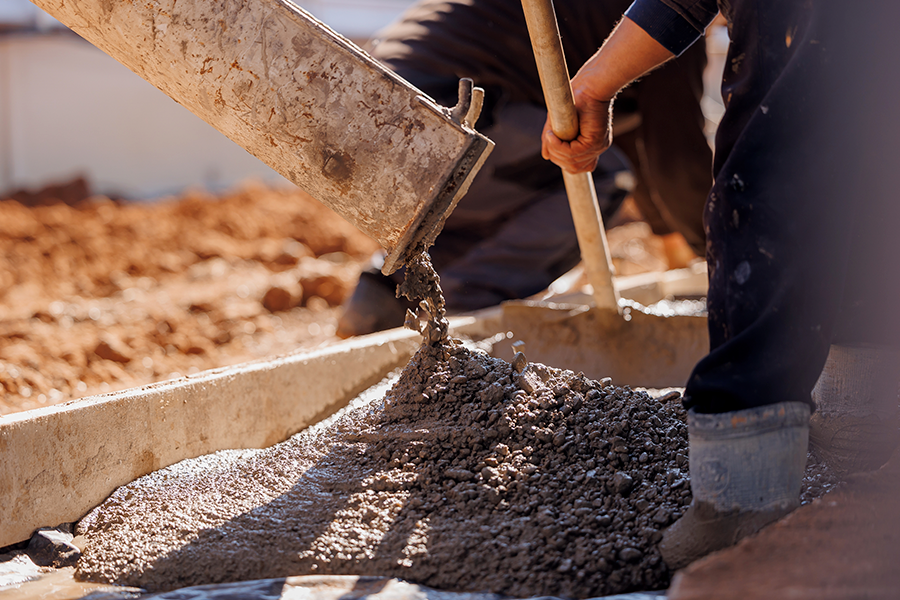
Concrete is the most widely used material in construction in Chile and around the world. However, its production involves high environmental and economic costs, which call for innovative solutions to optimize its performance.
Current chemical additives and cement replacement materials offer improved properties and sustainability. However, high industry requirements demand even more advanced alternatives. This has led to the exploration of bio-concrete, which is valued for its ability to self-repair cracks, thereby significantly extending the material's useful life.
To increase the strength, durability, and sustainability of concrete, the University of Santiago is promoting the ANID-funded Fondef project: "Development of a bioadditive to improve the performance of concrete." The research is a collaborative effort involving CTeC, industry partners Polpaico and Melón, and the support of the Technology Management Department of Vriic.
"This year's focus is on developing a liquid additive containing active bacterial spores, which we incorporate directly during concrete mixing. The selected bacteria precipitate calcium, generating microcrystalline structures within the cement matrix. This unique process improves the material's strength and effectively reduces volumetric shrinkage," explains Dr. Leonardo Brescia, project director and academic at the Department of Civil Engineering.
One of the major challenges of using traditional concrete is its high demand for water and cement, which makes its production more expensive and increases the environmental footprint of construction. “By improving mechanical strength through bioadditives, we can reduce the amount of cement needed to achieve standard structural strengths, with the resulting economic and environmental savings,” the researcher points out.
In this way, the project aims to simultaneously reduce cement consumption, extend the useful life of structures, and effectively drive the construction industry toward a more sustainable and competitive future.
Interdisciplinary Collaboration
The research at Usach is inherently interdisciplinary, utilizing expertise from both the Faculty of Engineering and the Faculty of Chemistry and Biology. The project successfully integrates structural engineering, materials science, and microbiology for its execution.
The interdisciplinary effort at Usach involves several key participants across different departments: the Construction Systems and Materials Laboratory, led by Dr. Leonardo Brescia; the Molecular Microbiology Laboratory (Chemistry and Biology), headed by Dr. Felipe Arenas; and the Materials Laboratory (Metallurgical Engineering), led by Dr. Rodrigo Allende. Further expertise is provided by Dr. Carlos Guzmán, the project's alternate director and an expert in materials and structures modeling, and researcher Dr. Angela Plaza, who specifically facilitates communication and integration between the distinct fields of microbiology and engineering.
“The work and the results achieved are based on the experience and expertise of this team in different areas, with the capacity to develop a technological product that provides solutions to the needs of industry and society,” emphasizes Dr. Brescia.
The project is scheduled to last 24 months and includes five stages. The first stage involves generating controlled genetic mutations in the bacteria, which serves two purposes: ensuring their intellectual protection and improving their behavior in the concrete's alkaline environment. The second stage will focus on experimental validation in the laboratory, specifically by conducting resistance tests using various bacterial formulations.
The third stage focuses on performance evaluation under real conditions. As Dr. Brescia explains, "The validation will occur in an industrial park, where we'll build concrete prototypes to evaluate their evolution in a real environment. This will be achieved with support from CTeC and companies Melón and Polpaico, which will supply raw materials and collaborate on the experimental trials."
Following this industrial validation, computational modeling and structural analysis will be carried out in the fourth stage to estimate potential material savings and explore novel applications, such as 3D printing.
The research will conclude in the fifth stage with the development of the product's technical specifications, including detailed information on its stability, methods of use, and storage requirements.
Advancing Technological Readiness
The project includes the acquisition of specialized equipment, such as climate chambers, industrial mixers, a press, a test chamber, and production scaling systems. "These resources are essential for validating the bioadditive's performance and advancing the technology to a level of maturity near TRL 6 (Technology Readiness Level 6)," the academic notes. "This level is critical, as it opens the door to scaling the solution into scientific ventures or commercial licensing processes."