


Amid rising global temperatures and accelerating carbon emissions, carbon recycling is emerging as a critical sustainability solution. Around the world, advanced (CO₂ ) capture and conversion technologies are converting greenhouse gases into valuable commercial feedstocks through more sustainable processes.
In response to this, Dr. Isaac Díaz, a faculty member in the Department of Chemical and Bioprocess Engineering, is leading a Fondecyt Start-up Project that aims to develop an electrocatalytic material capable of efficiently and selectively converting CO₂ into formic acid through electrochemical reduction.
“It is important to study CO₂ reduction today not only because of global warming, but also because of the need to develop technologies capable of sustainably reusing this greenhouse gas and transforming it into new value-added compounds,” explained Dr. Díaz.
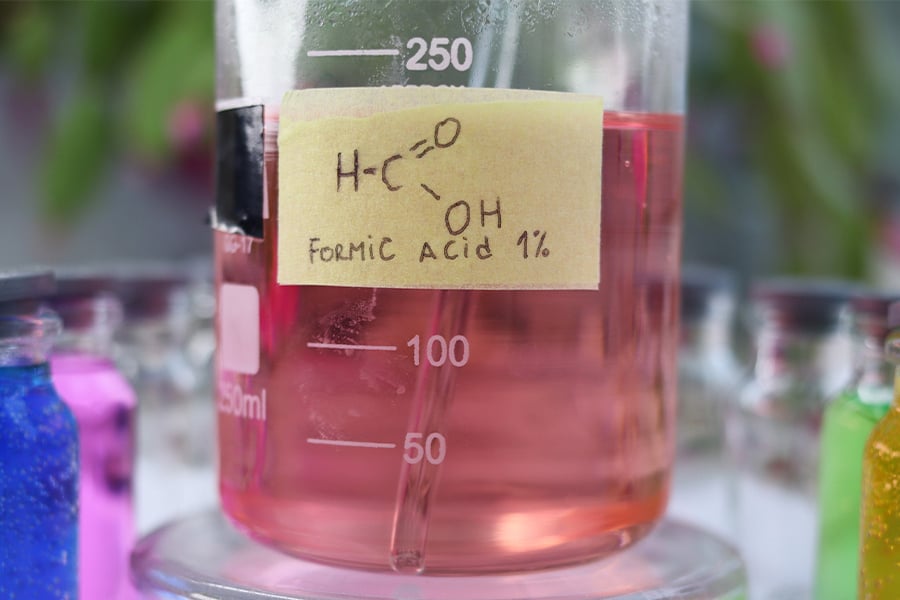
Formic acid is a chemical compound used in pharmaceuticals, food processing, paints, and industrial chemical manufacturing. “Currently, global demand for formic acid is growing steadily at a rate of nearly 6% per year, so there is both interest and a market for this type of compound at the industrial level,” the researcher explained.
A primary goal of the research is to develop a highly selective reduction system to produce formic acid alone. “The process isn’t very specific, so it doesn’t produce just one compound but a range of compounds. Gases, alcohols, or other acids can be produced, and the problem is that separating that mixture afterward is costly and complex”, Díaz explained.
The research uses computer simulation to design materials that are subsequently synthesized and evaluated in the laboratory. “We’ve learned that, through computational modeling, we can then transfer those results to the laboratory and develop a material with similar characteristics,” the researcher commented.
To this end, the research team—composed of Dr. Díaz and Usach doctoral and undergraduate students—computationally designed a material capable of capturing CO₂ and converting it directly into formic acid.
“We have graphene sheets, boron nitride sheets, and tin oxide on top of the graphene. All these materials contribute specific properties and ultimately form a composite that acts synergistically and can adsorb or capture CO₂ on its surface and then convert it directly into formic acid,” the researcher explained.
Preliminary tests have shown promising results in terms of both the process’s efficiency and selectivity. “We currently have an efficiency of around 72%, comparable to what has been reported in the literature, but we have not yet fully optimized the process,” said Dr. Isaac Díaz.
The researcher added that, “thanks to a collaboration between chemistry and biology, we were able to experimentally validate the selective production of formic acid. We used nuclear magnetic resonance spectroscopy to measure the components present in the products, and formic acid was present—and no other product. There were no alcohols, hydrocarbons, or other substances present.”
During the second and third years of the project, the researchers will scale operations from laboratory H-type cells to continuous-flow electrochemical cells. This transition aims to improve energy efficiency and increase production volumes.
“One of the hypotheses of this work is that if we change the shape of the cell, we could achieve better conversion and a more efficient process,” explained Dr. Díaz.
The research includes collaboration with an Italian university, featuring academic exchanges and visits by specialists in advanced materials characterization. Additionally, the project is being carried out at the Energy Laboratory of the Department of Chemical and Bioprocess Engineering.
“The future goal is to move beyond basic research. We want to conduct technological research, develop a technology, protect it, and then transfer it to a company,” concluded Dr. Isaac Díaz.