


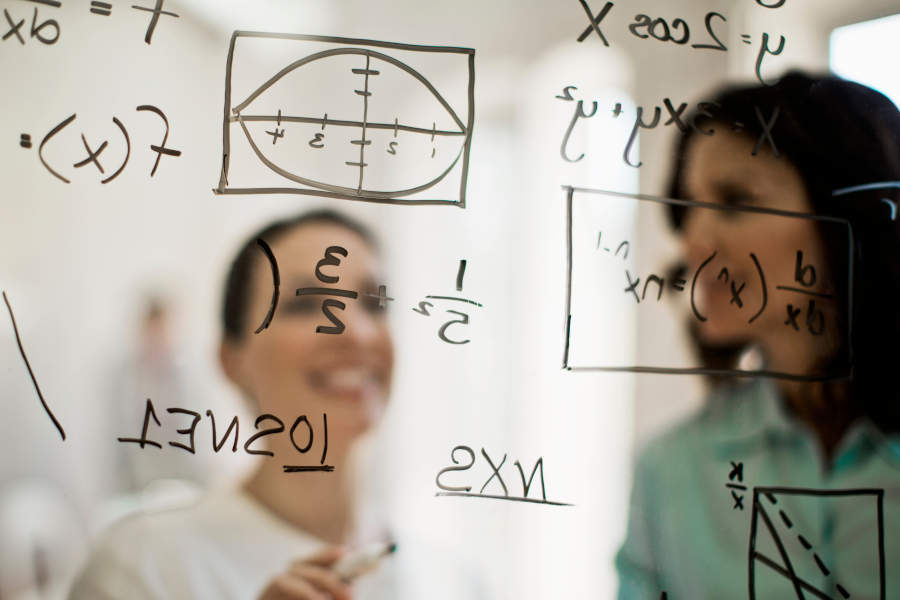
Whether predicting weather patterns, mapping neural behavior, or tracking disease transmission, mathematical models allow researchers to decode how the physical world operates and anticipate future scenarios.
For a long time, these models were built on the assumption that certain phenomena unfold gradually—that is, in a more or less predictable way—and that each event depends primarily on what is happening in its immediate surroundings. However, reality often behaves in more complex ways.
For example, if a wildfire breaks out, classical models assume that the fire will spread from one tree to the nearest ones, but in practice, a spark can be carried by the wind for kilometers and ignite a new fire far from the original one—a behavior that traditional models do not always accurately explain.
This type of phenomenon is part of what researchers refer to as anomalous diffusion, a field of study that seeks to understand processes that do not evolve conventionally, which is becoming increasingly relevant today in areas such as materials science, nanotechnology, and engineering.
At Usach, Dr. Carlos Lizama, a faculty member in the Department of Mathematics and Computer Science, is leading a Fondecyt Regular 2026 project to develop new mathematical tools to understand complex phenomena that traditional models do not always accurately describe.
The work builds on the researcher’s expertise in functional analysis, operator theory, and evolution equations—fields in which he has developed tools for studying continuous, discrete, and nonlocal models.
“With technological development, phenomena began to emerge that traditional mathematical models could not fully describe. This led to a search for new answers, and tools that had long seemed somewhat exotic—such as fractional derivatives—began to play an increasingly important role in describing these processes,” the researcher notes.
In simple terms, fractional derivatives allow for the incorporation of elements that traditional mathematics tends to leave out. At the same time, classical models describe phenomena that progress step by step and depend primarily on what is happening in the present; these tools can account for effects that extend over greater distances or the influence of past events on a system’s future behavior.
Unlike classical models that omit historical context, non-local mathematical modeling explicitly incorporates memory, recognizing that past states directly influence future system behavior. “What we’re seeking is to understand how these phenomena evolve—such as the spread of fires, the behavior of advanced materials, or certain processes observed in biology and nanotechnology—and to build mathematical models that increasingly approximate what actually happens in nature,” explains Dr. Lizama.
A prime example of memory in physical systems is found in viscoelastic materials, which deform and recover their original shape by retaining information about their past states. The overarching goal of this research is to identify and refine predictive mathematical tools that accurately model these material dynamics and forecast their evolution over time.
The project will run for four years and is organized around eight research problems aimed at deepening our understanding of evolution equations and anomalous diffusion phenomena. To this end, the team will study different scenarios and mathematical models, analyzing aspects such as the behavior of solutions, their evolution over time, and the influence of physical parameters on these processes.
A significant part of the work will focus on studying continuous and discrete systems, and developing new theoretical tools to help understand complex phenomena present in various areas of science and technology. In this context, the central objective is to build a robust mathematical foundation to address these phenomena with greater precision.
To this end, the project will combine tools from functional analysis, operator theory, differential equations, and various mathematical methods developed over the past few decades. This is complemented by an active international collaboration network comprising researchers, doctoral students, and academics from universities in Latin America, Europe, the United States, and Australia.
“I hope that we can solve the problems posed by the project and generate new knowledge that contributes to the development of this field. These are complex mathematical challenges, but that is precisely what makes them so interesting: advancing questions that do not yet have a complete answer and continuing to push the boundaries of what we know,” concludes Dr. Lizama.