


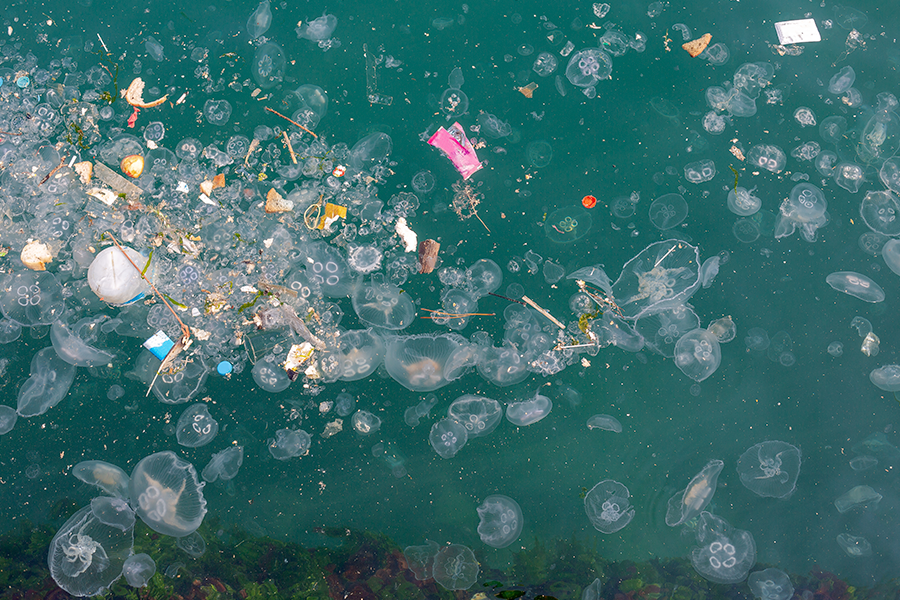
In recent decades, human activity has severely threatened natural marine habitats, including reefs, estuaries, and mangroves.
The increasing expansion of underwater and coastal infrastructure poses a major threat, with the construction of ports, breakwaters, and platforms leading to significant ecosystem alterations.
Compounding these challenges, coastal urbanization and pollution have led to an intensification of phenomena such as eutrophication. This refers to an overabundance of nutrients that diminishes water quality and constricts the living space available to many species. Such impacts imperil not only the survival of marine biota but also the ecological resilience of ocean ecosystems against the effects of climate change.
To tackle these pressing issues, Dr. Claudio García, a researcher at Usach's Faculty of Engineering and director of its Biomechanics and Biomaterials Laboratory (Department of Mechanical Engineering), joined forces with Dr. Marco Lardies (Adolfo Ibáñez University) and Nelson Lagos (Santo Tomás University). Together, their team developed a modular coating slab for marine structures, specifically designed to restore degraded habitats.
"Our proposal centers on an adaptable system crafted from bio-enhanced concrete," states Dr. Claudio García. "This innovative material blends marine cement with calcium carbonate (CaCO₃), and is molded into three-dimensional shapes, offering varied structural complexities."
"These slabs feature customizable reliefs, grooves, and undulations, allowing their shape, direction, and quantity to be tailored to the local ecosystem's needs," Dr. García further explained. "This design replicates the natural complexity of marine habitats, which promotes species colonization and, consequently, enhances the environment's biodiversity and resilience."
Concluding, Dr. García emphasizes that a key advantage of this technology lies in its ecologically integrated approach, which stands in stark contrast to conventional, generic solutions. He adds, "Its inherent adaptability enables more effective restoration of specific habitats, thereby contributing to the sustainable recovery of ecosystems impacted by human activity."
This innovation developed at Usach is currently in the process of being patented in Chile, supported by the Technology Management Department of the Vice-Rector's Office for Research, Innovation, and Creation.
For more information on the University's technology portfolio, please visit the Technology Management Department's website.