


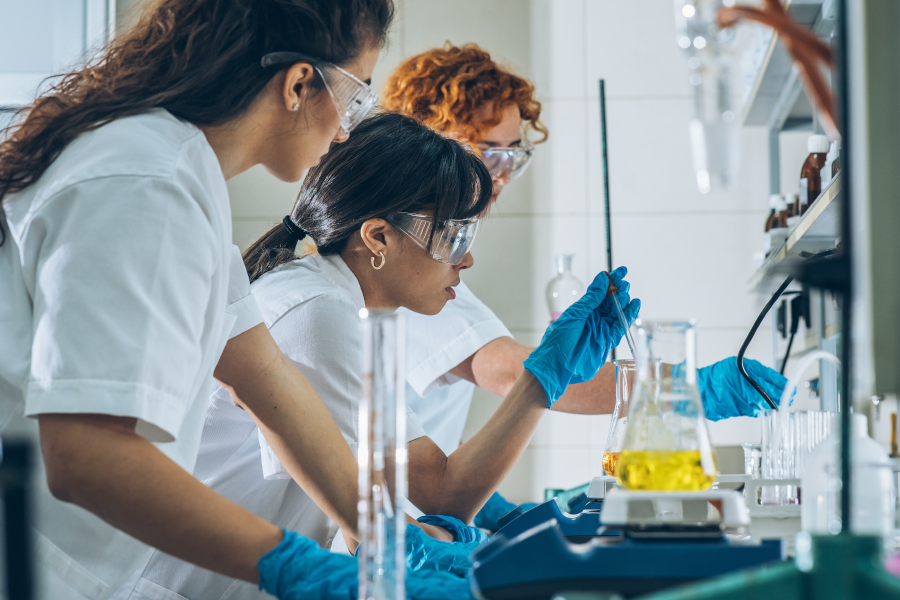
Since earning her degree in chemistry, Dr. Karen Manquián Cerda has specialized in soil chemistry, analyzing complex molecular interactions beneath the surface. Her current environmental research investigates how natural nanoparticles (NNPs) and industrial or engineered nanoparticles (ENPs) alter the bioavailability of heavy metals and essential nutrients in soil ecosystems. Ultimately, her goal is to translate this nanotechnology data into scalable solutions that improve agricultural sustainability and public health.
As a child, her curiosity drew her sequentially to mathematics and physics, but she ultimately found her calling in chemistry. For Dr. Manquián, chemical science offered the most direct bridge between foundational STEM knowledge and developing tangible solutions for concrete environmental and industrial challenges.
After earning her Ph.D. in Natural Resource Sciences at the University of La Frontera, she returned to the University of Santiago de Chile, where she had completed her undergraduate studies. There, she joined the Soil and Environment Laboratory in the Faculty of Chemistry and Biology, where she began studying the environmental impact of the interaction between NNPs and ENPs; she is currently developing nanoremediation technologies.
She is currently an assistant professor and head of the University Technician program in Chemical and Physical Analysis, a role to which she added, in 2024, the coordination of the Women’s Leadership and Participation Initiative at the Science Up Consortium.
For an academic, the roles of dedicated educator and cutting-edge scientist are often lived in unison—a synergy visible in any casual hallway chat with students. Yet, behind the scenes, a deeper question remains: how does this dual identity shift when factoring in parenthood? Navigating the intersection of motherhood and a career in science presents unique structural challenges that many researchers face today.
Addressing the cultural challenges of women in academia, she notes that systemic bias often hides behind everyday routines: “While training as a scientist, I never explicitly felt the barriers. It’s only when we analyze it deeply that the issues surface, because social expectations around being a woman, a scientist, and a mother are completely normalized.”
Fortunately, shifting student demographics are accelerating change. An increasingly empowered generation of students is helping break down traditional biases, challenging the rigid stereotypes that were routinely accepted and legitimized in scientific faculties decades ago.
Addressing the historical bias against women in academia, she recalls an environment where professional credibility was routinely challenged by gender-imposed limits.
“For some, being a woman scientist came with gender-imposed limits—for example, having children, where they would openly say that I should stop researching and devote myself to caring for the children,” she recalls.
This overt discrimination created a culture where femininity was actively rejected and viewed as a sign of incompetence—a historical factor that directly fuels the lack of visible female scientific role models in contemporary media, even though there was already a greater presence of women in her field back then.
“Those comments that used to be made openly are no longer accepted by society today, although there is still a long way to go. That’s why role models are so important—to show that there isn’t just one way to be a scientist, that women don’t have to choose between science and having a family, and that the difficulties often endured in silence have already been faced by others. Because, despite the challenges imposed by society, they have proven that their quality is not in question—but we still have to keep moving forward,” she concludes.