


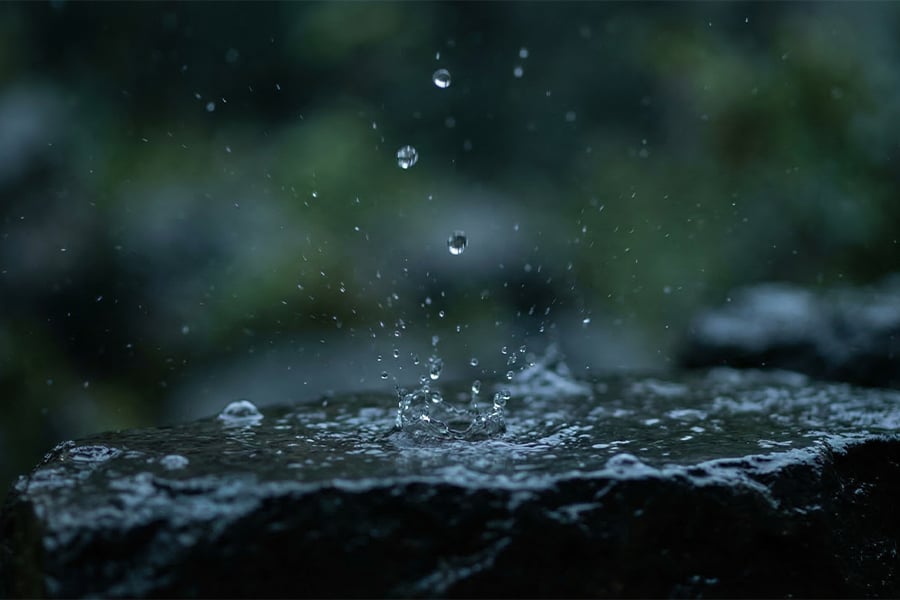
“A drop of water wears away a stone” is a saying we’ve probably heard more than once. Attributed to the Chinese philosopher Lao Tzu more than 5,000 years ago, it is often interpreted as a metaphor for perseverance and consistency; however, behind this popular phrase lies a scientific question that, to this day, remains without a definitive answer.
Although the phenomenon seems obvious, physics has yet to explain how a drop of water—incapable of breaking a rock with a single impact—can eventually erode it by falling repeatedly on the same spot.
Resolving this apparent contradiction is precisely the challenge that Dr. Leonardo Gordillo, a researcher in the Department of Physics at Usach, seeks to address. He leads a Fondecyt Regular 2026 project that aims to understand the physical mechanisms behind erosion, using the phenomenon of a water droplet striking a stone as a starting point.
“The great challenge is that we are faced with a question that, despite having been known for millennia, still has no answer. We know that the successive impact of water droplets can erode a rock, but when one tries to explain exactly which physical mechanism makes this process possible, the available answers are still not satisfactory,” explains Dr. Leonardo Gordillo.
In simple terms, erosion is a natural process by which a material loses part of its surface due to the action of agents such as water, wind, or ice; in most cases, this wear occurs because the forces involved are intense enough to dislodge or deform the material.
In the case of a drop of water, however, an apparent contradiction arises: the energy of a single impact is too low to fracture a rock on its own, but when hundreds or thousands of drops fall on the same spot, the surface begins to wear away and form a crater—without having exceeded the threshold required to dislodge material.
"The first thing we discovered was that the crater does not appear immediately; it is only after 500 to 700 drops that a small indentation begins to form on a sample material. For a long time, we thought it was gradual wear, as if the drop were acting like sandpaper, but we’ve observed small events that resemble micro-explosions on the surface, as if tiny ‘little bombs’ were dislodging material until the crater formed,” explains Gordillo.
To observe this phenomenon, the team developed an experimental system capable of recording the evolution of the impact drop by drop; since each impact occurs in just milliseconds, the research uses high-speed cameras that capture up to 30,000 images per second. At the same time, an automated system moves the samples between the impact zone and an analysis station, where photographs and periodic measurements are taken, allowing the formation of the crater to be reconstructed step by step.
Over the course of its four-year duration, the project will continue to delve deeper into these findings through new experiments and physical models that will help us understand what happens inside the material when it is subjected to repeated water impacts.
By identifying the core mechanism of this type of erosion for the first time, researchers are laying the groundwork for the development of coatings and materials that reduce wear on infrastructure exposed to rain and other environmental agents, with potential applications in fields such as construction and aeronautical engineering.
The research also involves collaboration with international teams, including researchers from the University of Minnesota (United States) and erosion specialists from France, as well as joint work with students in the Physics Engineering and Physics Ph.D. programs at Usach, who are actively participating in the development of the experiments and the analysis of results.
“We hope that by the end of this project we will be able to provide a solid answer to this problem. Everything indicates that the interaction of water with the material’s pores plays a fundamental role, but we still need to gather more evidence to provide a definitive answer. That is precisely the challenge for the coming years and also what makes this research so exciting,” concludes Dr. Leonardo Gordillo.