


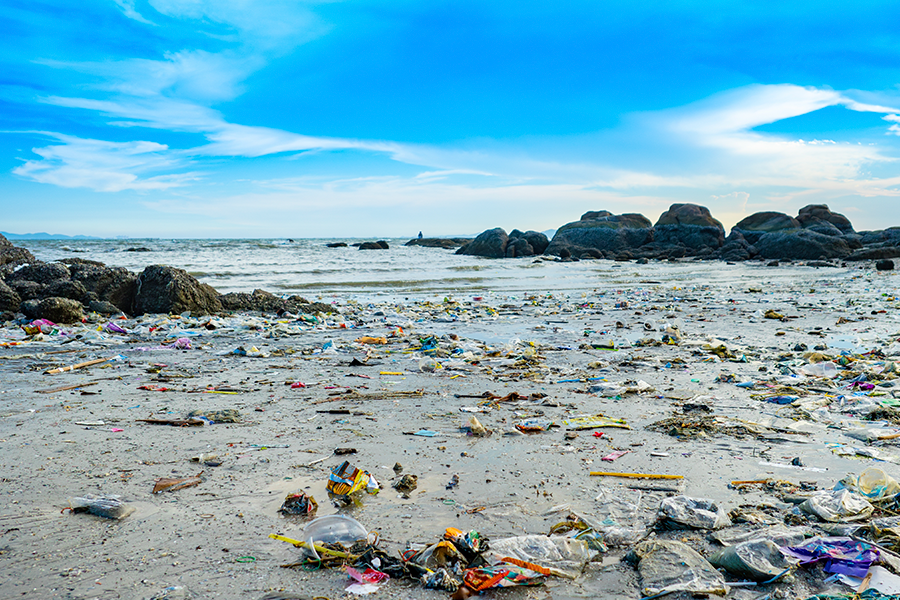
Despite public policies like the REP and Single-Use Plastics laws, plastic waste management remains a significant national challenge. According to Fundación Chile, our country consumes nearly one million tons of plastic annually, with only a meager 8.5% being recycled.
To address this challenge, the University of Santiago (Usach) has partnered with the Juan Fernández Circular R&D project. Led by CircularTec and funded by ANID, the project’s goal is to treat plastic waste from a circular economy perspective and develop useful products for the archipelago’s community.
Leading the initiative is Dr. Alexandre Carbonnel of the Laboratory for the Exploration of Environmental Architectural Materials (Lemaa). He works alongside a multidisciplinary team from the same unit, bringing together professionals in architecture, industrial design, and engineering.
From a technical perspective, the team seeks to provide a “concrete response to the problem of plastic accumulation in the archipelago by transforming it into new products,” says the academic.
Initial Progress
The first stage of the initiative has already seen significant progress, including a territorial survey by CircularTec. This survey was essential for measuring the quantity and types of plastics in the area and for identifying objects suitable for local production.
The data gathered allowed Lemaa’s research and innovation team to characterize the most common plastic products found on the islands. They were then able to evaluate their thermal and chemical behavior, along with other key properties.
Following the analysis, the team determined that polypropylene—a plastic found in bottle caps, drums, and containers—was the most suitable material for the new products. This led to the development of two prototypes. “Efficient management can reduce the ecological footprint and position the municipality of Juan Fernández as a benchmark in sustainability,” said Dr. Carbonnel.
CircularTec considers its joint work with Usach a successful collaboration with academia, promoting innovative solutions rooted in science and technology.
This collaboration is emphasized by Victoria Ulloa, a project engineer in Environment and Circular Economy at the center. She states that the goal has been to “devise alternatives that allow for the valorization of waste in situ, considering the needs and particularities of the archipelago,” all while maintaining the technical rigor, quality, and responsibility needed to create prototypes from recycled materials.
As the first phase of the project concludes, Dr. Alexandre Carbonnel shares the team’s future goals. “We hope to move on to a second stage to continue developing the proposed products, thus contributing to environmental care and the promotion of the circular economy,” he explained.