


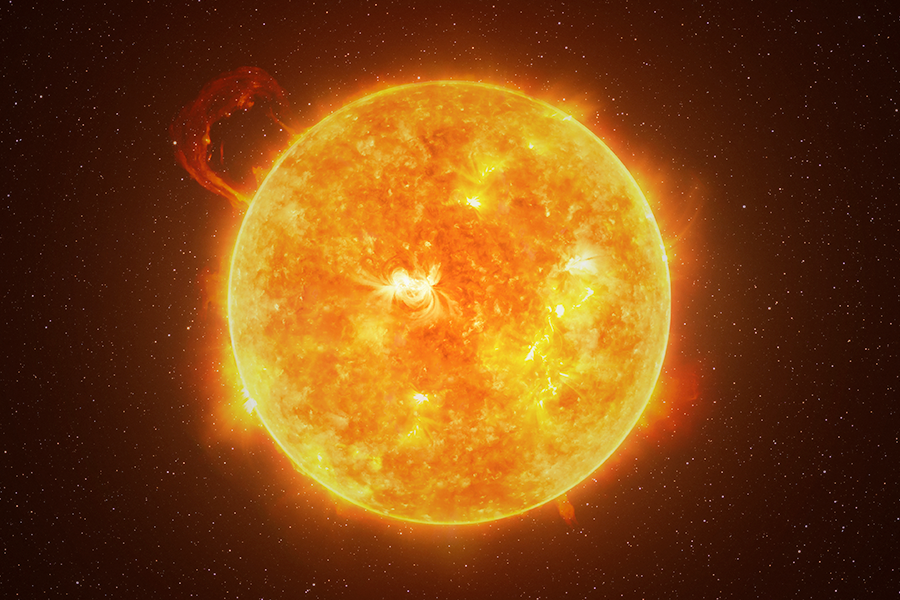
On March 13, 1989, a powerful solar storm caused the entire power grid in the province of Quebec, Canada, to collapse, leaving millions without electricity. In just ninety seconds, a massive cloud of charged particles from a solar explosion struck Earth's magnetosphere, generating a geomagnetic storm that completely paralyzed the system. The outage was not due to a technical failure or overload, but rather to this intense space weather event.
The magnetosphere is an invisible layer surrounding Earth, generated by our planet's magnetic field. Its primary function is to shield us from the solar wind, a constant flow of charged particles emitted by the Sun. When the Sun releases a large amount of energy, this flow intensifies, striking the magnetosphere with greater force and causing a geomagnetic storm.
When these storms are intense, they can create electrical currents in the ground that leak into power grids, overloading transformers, damaging equipment, and causing blackouts like the one in Quebec. These storms can also interfere with GPS, satellite communications, and air navigation systems, directly affecting essential services worldwide.
Dr. Marina Stepanova, a physicist at Usach, is leading a Fondecyt Regular project to understand how solar storms originate and how the magnetosphere responds to them. Her research focuses on how the magnetosphere's balance is disrupted and then reorganizes itself to regain stability after a geomagnetic storm.
"The magnetosphere is a system where dynamic, magnetic, and plasma pressures coexist in a natural balance. When a disturbance, such as a solar flare, disrupts this balance, the system tries to adapt. If it can't adapt quickly, it generates compensatory processes like geomagnetic storms," explains the academic.
International Collaboration Network
To investigate these imbalances, the study will analyze data from various international space missions. The satellites, orbiting at different altitudes, allow for the simultaneous observation of multiple regions of the magnetosphere. This approach helps to understand how a disturbance propagates within the system.
"Scientific satellites are expensive projects, but thanks to an international open-access policy, anyone can now download space physics data free of charge. Some missions orbit very far away, tens of Earth radii, and others that fly almost grazing the atmosphere. This variety allows us to observe different regions of the magnetosphere and understand how it behaves as a complete system," explains the academic.
In addition to working with satellites and ground-based sensors, the project has an international network of collaborators, including NASA and research teams in Russia. These partnerships provide access to advanced data, enable the sharing of methodologies, and allow results to be compared with other groups specializing in space physics.
"Space physics doesn't work with absolute truths. It's not about one group being right and another being wrong. Often, different perspectives complement each other, and it's through this collaboration that knowledge advances. That's why we work with NASA, with colleagues in Russia, and with other teams: because this type of science requires building together," she says.
The project is a four-year initiative and is part of a long-term scientific effort to understand the space environment surrounding Earth. This research, conducted in Chile with international collaborators, aims to contribute to global knowledge of space weather and its impacts.
"In science, you start with a hypothesis and a hunch, but testing it requires time and resources. Because the results aren't always what you expect, you must always have a plan A, B, or C. Our project isn't a closed process; the first few years allow us to validate ideas, and the final years open the door to what comes next," concludes the academic.